REVIEW · CITY TOURS
Private Full-Day Jaipur Sightseeing Tour Explore the Pink City
Book on Viator →Operated by indiatourcabs · Bookable on Viator
Jaipur can feel like a blur of monuments unless you have a plan. This private full-day route strings together the big hitters of the Pink City in one smooth day, with door-to-door pickup and an air-conditioned taxi so you’re not wasting time in traffic. I like the “see more, stress less” pacing, especially when you’re hopping between landmarks like Amer Fort and Jantar Mantar. I also like that the driver experience seems to matter here, with reviews calling out Hukam as kind and reliable. The one drawback is simple: it’s a packed day, so if you prefer slow sightseeing or only want one or two sites, this route might feel like a sprint.
If you book this with indiatourcabs, you get a private setup for up to four people, a mobile ticket, and all fees and taxes included. You’re starting at 7:00 am, so it’s a great choice for anyone who wants to beat the busiest parts of the day and still cover major sights. Just keep in mind the tour notes it requires good weather, so plan for an alternate date or a refund if conditions don’t cooperate.
In This Review
- Key things to know before you go
- Private Jaipur in one day: the value of a door-to-door car
- Amer Fort: how to plan for the hilltop payoff
- Panna Meena ka Kund: the stepwell that slows you down
- Jal Mahal over Man Sagar Lake: a photo stop with context
- City Palace and the royal “museum” vibe
- Jantar Mantar UNESCO: the science stop that doesn’t feel dry
- Hawa Mahal: make the windows your target
- Albert Hall Museum and Birla Mandir: contrast in style
- Jaipur shopping stops: Johari Bazaar and Bapu Bazaar without the chaos
- Price and what you’re paying for ($73 per group, up to 4)
- Who this one-day Pink City route suits best
- Should you book this Jaipur One-Day Sightseeing Tour?
- FAQ
- What time does the Jaipur tour start?
- Is this a private tour?
- How many people can be in a group?
- What is included in the tour price?
- What is not included?
- Is pickup offered?
- Do I get a mobile ticket?
- Are service animals allowed?
- What is the cancellation and weather policy?
Key things to know before you go
- Private, climate-controlled taxi: You ride in comfort with a driver, not a shared bus.
- Door-to-door pickup and drop-off: You don’t have to coordinate separate transport between sites.
- A tight lineup of Jaipur icons: Amer Fort, Panna Meena ka Kund, Jal Mahal, City Palace, Jantar Mantar, Hawa Mahal, Albert Hall, Birla Mandir.
- UNESCO stop built into the schedule: Jantar Mantar is included and is UNESCO-listed.
- Shopping time in the plan: You’ll hit major bazaars like Johari Bazaar and Bapu Bazaar for souvenirs and crafts.
- Strong customer feedback: A 5/5 rating from 36 reviews and 100% recommend it.
Private Jaipur in one day: the value of a door-to-door car

Jaipur is spread out enough that transport can eat your day. What I like about this tour is that it treats logistics as part of the sightseeing. You start at 7:00 am, get picked up, then move from site to site in a private, air-conditioned vehicle with a professional driver. For a one-day plan, that matters more than most people expect.
The group size is small—up to four—so you’re not stuck in a crowd with strangers trying to manage everyone’s pace. The tour is also private in the sense that it’s only your group, which usually makes it easier to ask the driver for a quick change of plan if something runs long at a stop.
One practical point: this route is built for covering highlights efficiently. That’s great if you want maximum sightseeing without juggling guides, tuk-tuks, and timing. If you’re the type who wants to linger for hours in one place, you’ll feel the “full-day” rhythm.
You can also read our reviews of more city tours in Jaipur

Amer Fort: how to plan for the hilltop payoff
Amer Fort is the first major stop for a reason. It’s one of the classic Jaipur experiences: a hilltop fortress with wide views and strong Rajput storytelling embedded into the setting. Even if you only know Amer Fort by reputation, being there in person helps it make sense. You can see why it’s a must on any first trip to Jaipur.
I’d approach Amer Fort with two goals:
1) Take in the views from the fort’s higher positions.
2) Focus on the fort as a whole complex, not just one photo angle.
A consideration: fort sites often involve a bit of walking and changing elevations. If you’re traveling with mobility constraints, it’s worth planning ahead so you don’t get surprised by stairs and uneven ground.
Panna Meena ka Kund: the stepwell that slows you down
After Amer, the schedule takes you to Panna Meena ka Kund, a 16th-century stepwell with an intricate, symmetrical design. This stop feels different from the usual palace-and-temple route because it’s about geometry and water engineering. It also gives you a nice break in tone: you’re not just moving from one ornate building to the next; you’re seeing a carefully designed structure made for a daily purpose.
What makes it memorable is how visually ordered it is. You get that moment where the place makes sense as a system, not just a background sight. If you like details—how parts align, how light behaves across stone—you’ll enjoy this stop a lot.
Downside? It’s not the biggest “wow from far away” site like a fort. If you want spectacle only, this may feel quieter. But it’s exactly that calm focus that makes it stand out on a packed day.
Jal Mahal over Man Sagar Lake: a photo stop with context

Next up is Jal Mahal, the Water Palace in Man Sagar Lake. This is one of those places that looks best with context: palace imagery meets lake setting, and the whole scene feels designed for views. Even if you’re mostly there for photos, you’ll still get something out of understanding how it sits in the landscape.
Because it’s on the lake, you may find the atmosphere changes depending on the day’s light and weather. Since the tour notes it requires good weather, that matters here. If conditions are dull or visibility is poor, the visual impact can be reduced.
The key is to treat Jal Mahal as a palate cleanser: a short, scenic stop between palace-style monuments and the more structured landmark stops coming later.
City Palace and the royal “museum” vibe
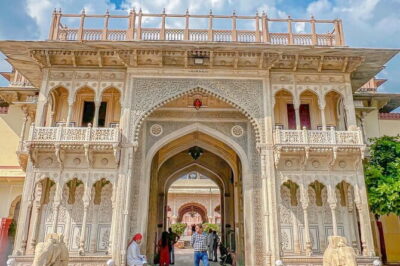
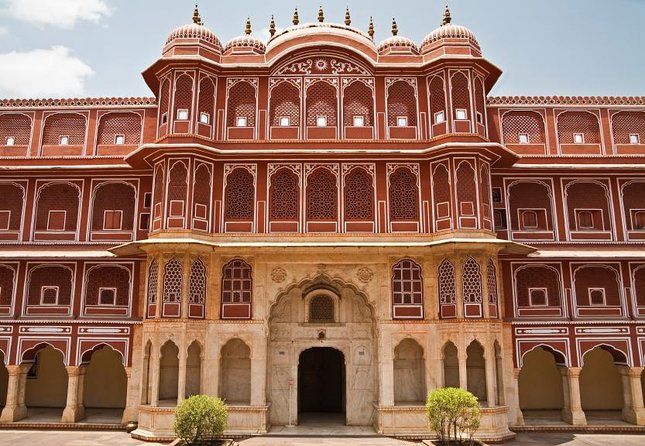
Then it’s City Palace, a royal residence with courtyards, museums, and artifacts. This is where Jaipur’s story starts to feel like it’s contained in one organized place. You’re not just looking at buildings from the outside—you’re stepping into a complex where the details are part of how the palace functioned.
If you like learning as you go, City Palace is a smart anchor stop. It helps connect the dots between Amer’s fort world and the city’s later architectural style. Plan to slow down a little here, even within the full-day pace.
One practical tip: museums and courtyard complexes can be easier to enjoy if you keep your attention on layout—where you are in relation to the main structures—rather than trying to see every single corner. You’ll get more satisfaction from fewer focused moments.
You can also read our reviews of more private tours in Jaipur






Jantar Mantar UNESCO: the science stop that doesn’t feel dry
Jantar Mantar is UNESCO-listed, and it’s included in this one-day route. This is the big “wait, that’s not just random stones” stop. It’s an astronomical observatory, known for large stone instruments, including the world’s largest stone sundial.
What I like about adding Jantar Mantar to a Jaipur day is that it changes the type of sightseeing. You go from decorative architecture to functional design. Instead of judging a building by how it looks, you start judging by how it works.
The drawback is that Jantar Mantar can feel abstract if you don’t know what you’re looking at. If you’re the type who enjoys interpretation, spend a few minutes figuring out how each instrument relates to time and the sky. Even a small amount of context makes the site click.
Hawa Mahal: make the windows your target
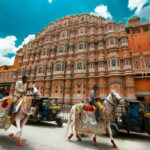
No Jaipur day feels complete without Hawa Mahal (Palace of Winds). The five-story facade is famous for its lattice windows, and this stop is a classic “look up” moment. What makes it worth your time is that it’s not just decorative; it’s part of how the palace was designed to interact with air and daily life.
When you’re there, I recommend focusing less on trying to see every viewpoint and more on studying the window pattern. It’s the detail that gives Hawa Mahal its identity. You’ll get better photos too when you commit to one or two strong angles.
A consideration: this kind of facade is popular, so timing and patience help. Since you start early, you’ll likely have an easier time than if you hit it mid-day.
Albert Hall Museum and Birla Mandir: contrast in style
After the core forts and royal architecture, the route includes Albert Hall Museum, Rajasthan’s oldest museum. This is a shift from monument architecture to collection-based storytelling. If you want a break from outdoor landmarks, museum time is a good way to recharge while staying in the historical conversation.
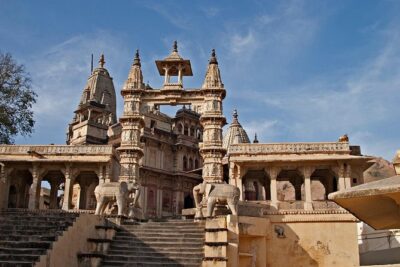
Then you move to Birla Mandir (Birla Temple), a white marble temple dedicated to Lord Vishnu and Goddess Lakshmi. This is a softer visual tone than the fort-and-palace palette. It also works well as a closing spiritual stop, giving your day a calmer ending before you head to markets.
If you’re trying to avoid fatigue, this two-stop sequence helps because it alternates visual texture and space: museum interior feel, then bright, open temple setting.
Jaipur shopping stops: Johari Bazaar and Bapu Bazaar without the chaos
A big part of this tour’s appeal is time for shopping markets, specifically Johari Bazaar and Bapu Bazaar. These are practical spots for Jaipur souvenirs—jewelry, textiles, handicrafts, and small gifts that feel more local than generic tourist counters.
Here’s how to shop well in a schedule like this:
- Decide what you want before you arrive (jewelry, textiles, small handicrafts).
- Keep your budget in mind early so you don’t get pulled into decision overload.
- Ask questions and check quality, especially on anything that looks like it has multiple versions.
Since this is a private tour, you’re not negotiating your way through transport while trying to shop. That’s a real quality-of-life upgrade, and it makes the shopping part feel intentional rather than stressful.
Price and what you’re paying for ($73 per group, up to 4)
The price is listed as $73.00 per group for up to four people. On paper, that could look “cheap” or “expensive” depending on your baseline. But the more useful way to judge value is this: you’re paying for a full-day private, air-conditioned car with a driver, plus all fees and taxes are included.
If you’ve ever tried to piece together a private day in Jaipur by hiring separate transport for each stop, you know how quickly time and cost can spiral. This tour turns that chaos into one package. It’s also ideal if you want reliable timing from place to place, since you’re not calling new drivers every time.
What’s not included: alcoholic beverages. So if you plan to have drinks during the day, budget for that separately.
For solo travelers, the per-person cost is still usually manageable because you’re not paying for an entire private vehicle alone in the traditional sense—you’re splitting within the group limit of four. For couples or small families, this can be a very cost-effective way to get a guided-style day without a big group.
Who this one-day Pink City route suits best
This tour fits best if you:
- Want the major Jaipur sights in one day.
- Prefer private transport over buses or shared vans.
- Are okay with a structured, full-day pace.
- Like having stops planned for you, but still want some flexibility through a driver.
It may not be the best match if you:
- Want a slow, one-neighborhood itinerary.
- Are very sensitive to long days of moving between landmarks.
- Want only one or two sites and plenty of free time afterward.
Should you book this Jaipur One-Day Sightseeing Tour?
If you’re doing Jaipur for the first time and you want a practical route that covers the essentials—Amer Fort, City Palace, Jantar Mantar, Hawa Mahal, museums, a temple, and shopping—this is an easy “yes” for me. The biggest reason is the private, air-conditioned setup with door-to-door pickup, which protects your time. And the feedback is strong, including a standout note about a driver named Hukam being kind and reliable.
Book it if you want a clean plan and less logistics stress. Consider alternatives if you’re traveling at a slow pace or you’d rather spend extra time at fewer places. Either way, starting at 7:00 am and building the day around weather-friendly scheduling is a smart move for most visitors.
FAQ
What time does the Jaipur tour start?
The start time is 7:00 am.
Is this a private tour?
Yes. It’s a private tour/activity, and only your group participates.
How many people can be in a group?
The price is per group for up to 4 people.
What is included in the tour price?
All fees and taxes are included.
What is not included?
Alcoholic beverages are not included.
Is pickup offered?
Yes, pickup is offered, with door-to-door service between your hotel and attractions.
Do I get a mobile ticket?
Yes, the tour includes a mobile ticket.
Are service animals allowed?
Yes, service animals are allowed.
What is the cancellation and weather policy?
You can cancel for a full refund if you cancel up to 24 hours in advance. The tour requires good weather, and if it’s canceled due to poor weather, you’ll be offered a different date or a full refund.