REVIEW · 4-DAY EXPERIENCES
4 Day Golden Triangle Tour to Agra and Delhi From Jaipur
Book on Viator →Operated by Imperial Holidays · Bookable on Viator
Golden Triangle in four days needs a plan. This tour is interesting because it runs like a smooth circuit—private guiding, door-to-door pickup, and an air-conditioned car—so you spend less time figuring things out and more time seeing the big sights.
I also like that the itinerary is built around mornings and landmark clusters. The sunrise Taj Mahal stop includes a guided visit inside for about two hours, plus the battery bus ride from the parking area up to the monument area to cut some walking and hassle.
One thing to weigh: entrance fees aren’t included (listed as about $60 per person total), and with so many stops, you’ll want to plan for long sightseeing days and early starts.
In This Review
- Key things I’d watch before you book
- What this Golden Triangle tour gets right for first-timers
- Jaipur in one day: forts, palaces, and that picture-perfect skyline
- Amber Palace (Amer Fort): the fort that steals the show
- Jal Mahal: a palace floating over the lake
- Jantar Mantar: where architecture doubles as science
- City Palace and Hawa Mahal: royalty, design, and city control
- Day 1 takeaway
- The road to Agra: Abhaneri stepwell and Fatehpur Sikri
- Chand Baori (Abhaneri): 3,500 steps of geometry
- Fatehpur Sikri: Mughal grandeur in red sandstone
- Arrive Agra: check-in and reset
- Agra day: Taj Mahal at sunrise, plus Fort and Baby Taj
- Taj Mahal at sunrise: why timing is everything
- Agra Fort: power behind the palace view
- Itmad-ud-Daula: Baby Taj as a quieter reward
- Transfer to Delhi
- Delhi half-day: Qutub Minar, India Gate, and government landmarks
- Qutub Minar: UNESCO scale in 60 minutes
- India Gate: a pause on Rajpath’s axis
- Sansad Bhavan and Rashtrapati Bhavan: government architecture you can recognize
- Agrasen Ki Baoli: the small stop with big vibe potential
- Drop-off when you’re done
- Private guide + private car: what that means in real life
- Price and value: where the $174.01 per person really lands
- Hotels, rooms, and the small details that affect your comfort
- Should you book this 4-day Golden Triangle from Jaipur?
- FAQ
- How long is the tour?
- Where does the tour start?
- Is this a private tour?
- Does the price include hotel stays and breakfast?
- How do we get to the Taj Mahal monument area?
- Are monument entrance fees included?
- What kind of vehicle is used?
- Is pickup and drop-off included in Delhi too?
- Do they provide water during the journey?
- Is free cancellation available?
Key things I’d watch before you book

- Private guides all day: you get local context without waiting for a big group.
- Sunrise focus at the Taj Mahal: built in for best timing and easier viewing flow.
- Battery bus to the Taj area: less time on foot, more time at the sights.
- Three hotel nights with breakfast (if you choose hotel option): you start each day fueled.
- Room setup is typically twin-sharing: if you’re traveling as 3 people, triple-sharing is the default unless you pay for 2 rooms.
- Entrance fees are extra: budget for the listed monument total.
What this Golden Triangle tour gets right for first-timers
The Golden Triangle is popular for a reason. Jaipur gives you grand palaces and forts tied to Rajasthan’s royal era. Agra delivers the main showpiece in the form of the Taj Mahal. Delhi adds layers of Indian governance, architecture, and everyday city life. The trick is doing it in a way that feels organized instead of exhausting.
This tour’s value is in the structure. You’re not bouncing between random taxis and ticket lines. You’re picked up in Jaipur, driven in a comfortable private air-conditioned vehicle, and moved with guides who can explain what you’re actually looking at. That matters on a route where every hour counts.
Also, it’s private, which changes the pacing. Instead of being squeezed between other people’s interests, you can keep to a rhythm that works for your group. The tour is even marketed as customizable, so the day flow is meant to adapt to what you care about most.
You can also read our reviews of more tours and experiences in Jaipur



Jaipur in one day: forts, palaces, and that picture-perfect skyline
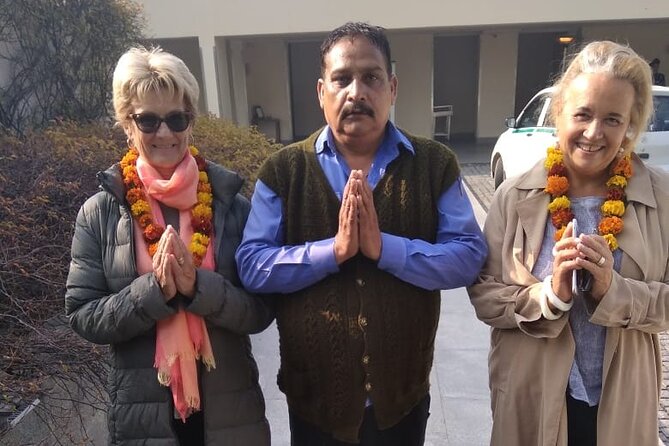
Day 1 is a classic Jaipur opener. You’ll begin with pickup from your hotel or from Jaipur’s airport/railway station, then go straight into a guided city tour. The order of stops gives you a nice mix: big viewpoints, historic complexes, and iconic buildings.
Amber Palace (Amer Fort): the fort that steals the show
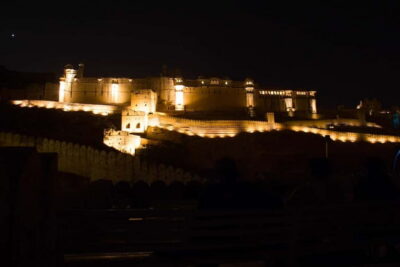
You’ll visit Amber Palace, also known as Amer Fort. It’s positioned up on a hill outside the city, and that setting is part of the impact. Even if you only spend a short time there, the fort’s scale and the way it overlooks the area makes it feel like more than a quick stop.
Practical note: forts involve walking and uneven surfaces, so wear shoes you can trust. If you’re sensitive to heat, plan to take water breaks when your guide suggests them.
Jal Mahal: a palace floating over the lake
Next is Jal Mahal, the palace in the middle of Man Sagar Lake. You’re not just looking at a building—you’re seeing how Rajasthan’s royal design worked with landscape and water. It’s quick, but it helps break up the intensity of fort and palace touring.
Jantar Mantar: where architecture doubles as science
Then comes Jantar Mantar, a collection of astronomical instruments built by Sawai Jai Singh II. It’s one of those places where your brain turns on: you’ll see structures that look decorative at first, then realize they’re tools for measuring time and the sky.
If you’ve ever wondered how people did serious astronomy without modern tech, this is a strong, focused stop. The guide matters here; with the right explanation, it’s far more than a photo stop.





City Palace and Hawa Mahal: royalty, design, and city control
You also visit City Palace of Jaipur, a complex established by Sawai Jai Singh II. It helps connect Jaipur’s rise as a capital to the buildings you’re seeing today.
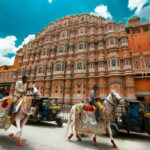
Finally, the tour includes Hawa Mahal, the famous palace façade made of red and pink sandstone. It’s tied to the zenana (women’s chambers) concept, and even without going deep into the story, you’ll feel the design idea right away: lots of window openings, built for visibility and presence in the street life below.
Day 1 takeaway
Jaipur on this schedule is a hit list, but it’s not random. You get the skyline drama (Amber), the design puzzle (Jantar Mantar), and two royal statement buildings (City Palace and Hawa Mahal). If you only have four days total, this is the kind of day that makes the rest of the trip feel worth it.
The road to Agra: Abhaneri stepwell and Fatehpur Sikri
Day 2 shifts gears. After breakfast, you travel toward Agra and stop on the way at two major sites: Chand Baori in Abhaneri and Fatehpur Sikri. Both are very different, which keeps the drive from feeling like dead time.
Chand Baori (Abhaneri): 3,500 steps of geometry
Chand Baori is famous for its massive stepwell, reached by about 3,500 steps. The point here isn’t only the age—it’s the design. You’re looking at an engineered space built for water storage and access. From the right angle, it becomes a pattern you can’t stop staring at.
This is also a great stop for people who like photography, because light and perspective change what you see each time you look down.
Fatehpur Sikri: Mughal grandeur in red sandstone
Then you visit Fatehpur Sikri, a small city founded by a 16th-century Mughal emperor, with red sandstone buildings clustered around its core. You’ll have roughly two hours there—enough time to walk, absorb the scale, and understand why it matters historically.
One drawback to keep in mind: big sites can feel like information overload if you’re tired. The best move is to go in with one question in mind, like how this place worked as a center of power, then let your guide’s explanation fill in the details.
Arrive Agra: check-in and reset
When you reach Agra, you check in at your hotel and get your overnight stay. That reset is important. Agra day 3 is intense, and you’ll appreciate having a full night to recover.
Agra day: Taj Mahal at sunrise, plus Fort and Baby Taj

Day 3 is the big crescendo. It starts with the Taj Mahal at sunrise, continues with Agra Fort, then finishes with Itmad-ud-Daula (often called Baby Taj), before moving on to Delhi for the night.
Taj Mahal at sunrise: why timing is everything
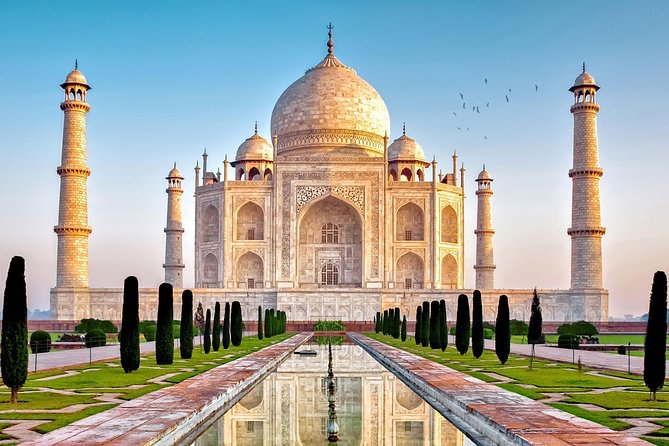
The tour schedules a Taj Mahal visit at sunrise, with a guided tour inside for about two hours. Even if you’ve seen pictures, seeing it in morning light changes your perception. The air is cooler, crowds tend to be more manageable than peak daytime hours, and the marble’s color looks different from what you’d expect.
Also, the itinerary includes a battery bus ride to and from the Taj Mahal parking area up to the monument area. That helps you conserve energy for the actual walk and viewing time. It’s a small detail that makes the experience smoother.
Practical tip: bring a hat and something for early morning chill if you run cold. Sunrise days can start cool and end hot fast.
Agra Fort: power behind the palace view
Next comes Agra Fort, a historical fort that was a main Mughal residence until 1638 when the capital shifted to Delhi. The fort is less about one iconic façade and more about how a ruling city functioned: defenses, royal presence, and layered architecture.
Expect this stop to feel like a shift from pure beauty (Taj) to structure and rule (Fort). If you like understanding how the city was built for control, you’ll probably enjoy this.
Itmad-ud-Daula: Baby Taj as a quieter reward
Finally, you visit Itmad-ud-Daula, the Mughal mausoleum often called Baby Taj. It’s usually less crowded than the main showpieces, and that gives you room to slow down and notice details.
If you want your three-hour-against-the-clock day to include at least one calmer stop, this is it.
Transfer to Delhi
After Agra, you go to Delhi and check in at your hotel for the overnight stay. This matters for how you feel on day 4. You’ll start with less stress than if you’d tried to see Delhi the same evening.
Delhi half-day: Qutub Minar, India Gate, and government landmarks
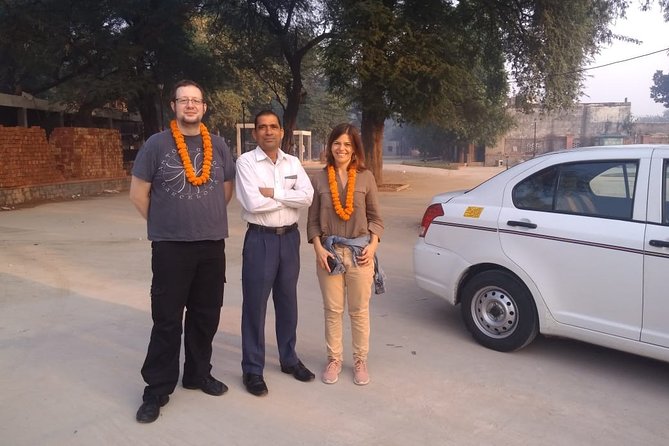
Day 4 is a half-day guided tour in New Delhi, then drop-off in Delhi, Noida, or Gurugram. The sights are spread along the central areas, so you get a sense of official Delhi without spending your whole day commuting.
Qutub Minar: UNESCO scale in 60 minutes
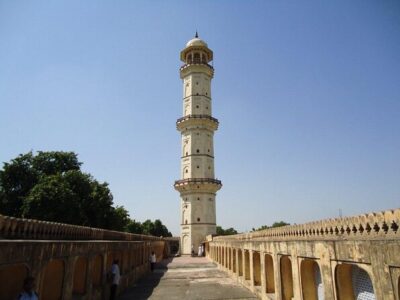
You’ll visit Qutub Minar, part of a UNESCO World Heritage Site. The minaret is listed at about 72.5 meters. That height shows up fast even if you only spend an hour. It also gives your eyes a vertical anchor, which helps when you’re looking at clustered complexes.
India Gate: a pause on Rajpath’s axis
Then it’s India Gate, a war memorial on Rajpath. The stop is short, about 15 minutes, but it gives context to Delhi’s ceremonial spaces. Think of it as a reset point after temple-and-fort scale.
Sansad Bhavan and Rashtrapati Bhavan: government architecture you can recognize
You’ll also see Sansad Bhavan (Parliament building) and Rashtrapati Bhavan (the President’s residence). These are part of the formal ceremonial geometry of central Delhi. You may not spend long inside anything here, but the presence of the buildings is the point.
Agrasen Ki Baoli: the small stop with big vibe potential
The tour finishes with Agrasen Ki Baoli, a protected monument. This one often feels more human-scaled than the giant landmarks around it. It’s also a nice contrast to the polished government scene: stepwell architecture with a different kind of historical texture.
Drop-off when you’re done
After the tour, you’ll be dropped off at your desired location in Delhi, Noida, or Gurugram. That flexibility is handy if your hotel isn’t right in central New Delhi.
Private guide + private car: what that means in real life

This is a private tour, and that isn’t just a marketing line. It changes the day-to-day experience in three ways.
First, it helps you keep momentum. Sightseeing here has a rhythm: ticket areas, walking routes, and then the explanation. Private guiding makes those transitions smoother.
Second, it reduces the mental load. You’re not trying to work out where to go next, what order makes sense, or how long a stop should take. Your driver and guide manage the flow, and transfer durations are approximate depending on traffic.
Third, comfort is actually built into the plan. You travel in a private air-conditioned car, and there are bottles of mineral water and soft drinks included during journeys. In hot months, that small comfort can be the difference between enjoying a site and feeling drained before the best part.
Car type adjusts with group size:
- 1–2 people: four-seater sedan
- 3–4 people: six-seater wagon
- 5–10 people: ten-seater van
Price and value: where the $174.01 per person really lands
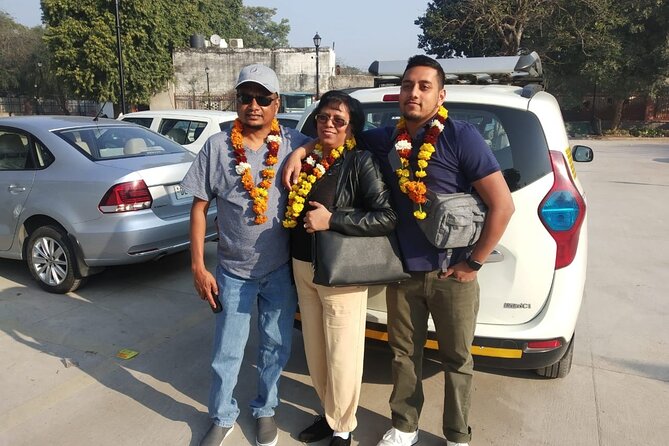
At $174.01 per person for a 4-day Golden Triangle circuit, the big question is what you’re paying for beyond the destinations. You’re mainly paying for:
- Three nights of accommodation and daily breakfast (if you select the hotel-included option)
- Private air-conditioned transport
- Private local guides at each stop
- Included touches like water/soft drinks during travel
- A less annoying Taj Mahal approach via battery bus
Now the catch: entrance fees are not included. The total listed monument entrance fee is about $60 per person. Your guide helps you buy entrance fees so you avoid waiting in line for tickets. That still adds cost, but it keeps your time intact once you arrive.
When this becomes good value is when you compare it to DIY. Doing this route on your own usually means multiple separate tickets, more decision-making, and more time spent negotiating transport. If you want the landmarks with fewer headaches, paying for the structure makes sense.
Hotels, rooms, and the small details that affect your comfort
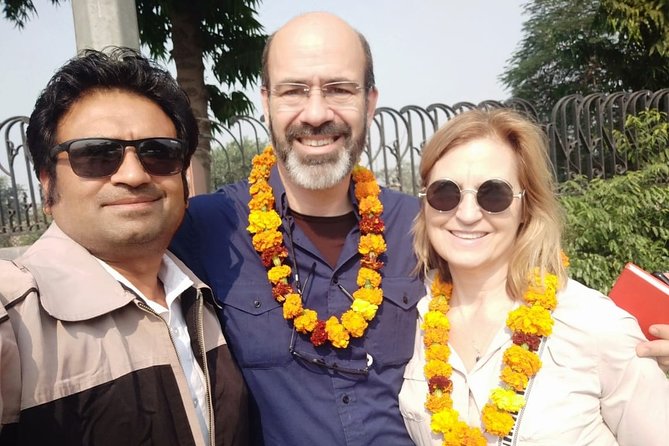
The tour includes three nights’ accommodation with daily breakfasts if booked with the hotel option. Rooms are generally twin-sharing by default.
Here’s the important part for groups of three: in a booking of 3 people, rooms are provided on triple-sharing by default. If all 3 guests prefer two rooms, there may be an additional charge. So if you’re traveling with a friend group and privacy matters, it’s worth checking before you finalize.
Also, the itinerary is built around a mix of outdoor and indoor stops. You’ll likely do a fair amount of walking at forts and archaeological complexes. Bring comfortable shoes and plan for heat.
Should you book this 4-day Golden Triangle from Jaipur?
Book it if you want:
- A private, guided route that covers Jaipur, Agra, and Delhi without hand-holding on navigation
- Sunrise Taj Mahal timing and a guided inside visit planned into the day
- Smooth logistics: pick-up, drop-offs, and a private car with comfort built in
Skip or think twice if:
- You dislike paying separate entrance fees on top of the tour price
- You’re hoping for a slow, laid-back trip. This is sight-heavy, and the best moments are early and scheduled.
If you want the classic Golden Triangle highlights with fewer trip-planning headaches, this is the kind of itinerary that tends to satisfy.
FAQ
How long is the tour?
It runs for 4 days (approximately).
Where does the tour start?
It starts with pickup in Jaipur from your hotel, airport, railway station, or another desired location in Jaipur.
Is this a private tour?
Yes. It’s listed as a private tour/activity, so only your group participates.
Does the price include hotel stays and breakfast?
Three nights of accommodation and daily breakfasts are included if you book the option that includes hotels.
How do we get to the Taj Mahal monument area?
The tour includes a battery bus ride to and from the Taj Mahal parking lot up to the Taj Mahal monument area.
Are monument entrance fees included?
No. Entrance fees are not included and are listed as about $60 per person in total. Your guide helps you buy entrance fees so you don’t wait in a separate queue.
What kind of vehicle is used?
Transport is in a private, air-conditioned car. The vehicle type depends on group size: sedan for 1–2, wagon for 3–4, and a van for 5–10.
Is pickup and drop-off included in Delhi too?
Yes. You’ll be dropped off at your desired location in Delhi, Noida, or Gurugram after the Delhi portion of the tour.
Do they provide water during the journey?
Yes. Bottles of mineral water and soft drinks are provided during journeys.
Is free cancellation available?
Yes. Free cancellation is allowed up to 24 hours in advance for a full refund.